Saturday, August 31, 2013

How to 'Cripple' Students

Recently, my next door neighbour gave me Stasiland by Anna Funder to read. It is a very moving and oftentimes horrific account of life in East Germany after the Wall went up, under the the constant monitoring and manipulation of the Stasi, the GDR secret police. The reign of paranoia, fear, obedience and acquiescence was not fiction from George Orwell's 1984 but actually happened to real people from the 1950's to 1989. A constant feature throughout was the insidious way the Stasi endeavoured to break the spirit of the populace in a calculated fashion (a theme covered so often in fiction by e.g. Orwell and Pink Floyd (for a tenuous link see Peer Review, Peer Exposure)). 

In the Notes on Sources at the end of the book, Funder reports that she later "found instructions to [Stasi] operatives on ways of crippling 'oppositional' people". The aims of these instructions were to:
      1. develop apathy (in the subject)
      2. achieve a situation in which in which his [/her] 'conflicts', whether of a social, personal, career, health or political kind are irresolvable
      3. give rise to fears in him [/her]
      4. develop/create disappointments
      5. restrict his talents or capabilities
      6. reduce his capacity to act
      7. harness dissentions and contradictions around him [/her] for [this] purpose
These are in essence, a list of ways to dehumanise someone. So getting to the point of this post in an educational blog: if any teacher, school leader, district administrator, politician or parent behaves or imposes an environment that achieves any of these aims, they are in fact contributing to the dehumanisation of the students in their care. I am not being melodramatic, this is happening in pockets (sometimes swathes) all across the Western world. Consider this, how many students:
      1. arrive at a school or a particular class invigorated and leave dejected and apathetic?
      2. find their social skills, personal lives, aspirations, abilities and individualism irreconcilable with 'school'?
      3. find that school raises their self-doubt, and they even fear attending?
      4. are set up to fail?
      5. have their wings clipped?
      6. find their opportunities limited and nonmeaningful?
      7. receive mixed messages about themselves such that they fade rather than flourish?
I am not suggesting that this is the plight of most students but it does happen and it shouldn't!

Turning a morose post on its head, if we use the antitheses of these points we empower students and let them 'fly'. Everyone in education and the establishment should strive to allow students to:
      1. develop a fervour for life and education
      2. find 'school' a place that embraces and adapts to their individual nature
      3. find their way through adolescence whilst feeling safe in school
      4. experience achievement
      5. find their individual talents encouraged and provided for
      6. be provided with meaningful opportunities and a genuine voice
      7. receive a consistent message of self-belief and self-worth and the necessary skills to be resilient and to flourish
Nothing but the best is good enough (see Nil Satis Nisi Optimum). Anything less is at best neglectful, or at worst crippling.

Monday, August 26, 2013

HSC Physics '1 More Mark' Tips

Today I was fortunate enough to present video conference to large bunch of Year 12 Physics students from across Sydney. I thoroughly enjoyed the experience, getting back into my Physics, the preparation, collaboration with colleagues and finally the delivery and discourse that ensued.

This was part of the 'HSC Masterclass: One More Mark' initiative being run to help lift our students from high Band 5 into Band 6 in the NSW Board of Studies Higher School Certificate examinations.

Here is the presentation. Please copy, re-edit, comment and critique to your heart's content.


Many thanks to my colleagues at work for organising and the various tips offered by fellow Physics teachers. Also a big thanks to Helen Fergusson and Derek Muller for their contributions. Recommended resources include:

"We are what we repeatedly do. Excellence, then, is not an act, but a habit." Aristotle
"All science is either physics or stamp collecting." Ernest Rutherford

BEST OF LUCK TO ALL YEAR PHYSICS TEACHERS AND STUDENTS!

Sunday, June 30, 2013

Cited by

After perhaps going overboard with citations in my own work, it is quite exhilarating to find my own research cited by esteemed academics. To this end, this blog post will be updated  (in reverse chronological order) if and when my research is cited by others.

November 2014, citing first paper:
Longley, M. (2014). Laptop. Edutech Wiki.  Retrieved November 30, 2014, from http://edutechwiki.unige.ch/en/Laptop

November 2014, citing first paper
Matheson, S. (2014). Science. Edutech Wiki.  Retrieved November 30, 2014, from http://edutechwiki.unige.ch/en/Science

January 2014, citing first paper
Beckman, K., Bennett, S., & Lockyer, L. (2014). Understanding students' use and value of technology for learning. Learning, Media and Technology, 1-22. doi: 10.1080/17439884.2013.878353

September 2013, overview of first paper:
Science Education News (September 2013) Seeing eye-to-eye on ICT: Student and Teacher Perceptions of Laptop use across 14 NSW Secondary Schools, Science Education News, 62(3), 149-150

June 2013, citing first paper

April 2013, citing first paper

citation needed by Dan4th, on Flickr
Creative Commons Attribution 2.0 Generic License  by  Dan4th 

Tuesday, June 18, 2013

Nil Satis Nisi Optimum 2013

Last week I ran a 'Cohort' at the Third National ITL Masterclass. The conference format was quite different and to my liking. Delegates were split into cohorts and worked with a facilitator over two days around a particular idea, developing an authentic product and acquiring skills and an extensive personal learning network in the process. 

I decided to run a new and improved version of the project as I did last year since it deserved another audience, this time NSW rather than SA. Entitled 'Nil Satis Nisi Optimum: Nothing But the Best is Good Enough', we examined the 'moral imperative' in teaching, the latest research, what good and bad teaching/eLearning/PD look like, why many teachers are reluctant to engage with technology and how we can help such teachers overcome their fears. All the while we engaged in a variety of technologies that the cohort picked up on as part of the process, rather than being drilled specifically e.g. Twitter, Prezi, Padlet, Creative Commons, Popplet, Weebly, VideoScribe, YouTube, Google Docs, Google Forms and Flickr.

The Prezi below contains all of the stimulus material used including quotes from Fullan and Hattie plus some excellent Creative Commons images from Flickr.
  

After getting things started we had a brainstorm about what a great teacher looks like using Padlet. The final results are below and can also be found here


The interesting thing about this exercise was that after the cohort did their initial brainstorm, @LiamDunphy put it out on Twitter and his PLN responded... from County Mayo, Tipperary, Virginia and even some Year 7 students from Sydney! This was an excellent demonstration of the power of Twitter, a PLN and global citizenship. 

Following the Padlet, the cohort discussed a series of questions and collated their answers in a Google Presentation (see below).


This Google Presentation was then used as a central crowdsourcing point, very much following the example of @TomBarrett's 'Interesting Ways'.

Over the course of the two days we worked and collaborated our way through the material, always with the end product in mind. To bring everything together, @LiamDunphy and @Largerama developed a Weebly, and,  to be a hit in the plenary showcase, @mrsdaedalus@rubeth and myself made a RSA Animate-esque VideoScribe explaining our work and @astrodidit @dlittle_mhs @nikki_dwyer @AnnaCoop112 @JeanetteBlack08 made a 'Harlem Shake' (see both videos below). 


Not that I'm competitive but I think we nailed the showcase presentation! 

It was a wonderful experience to work with Cohort 6 (and it was a great coup that the Keynote, Nick Jackson aka @Largerama, chose to join our cohort). I wish them all well as they take some of these ideas back to their schools and I look forward to working with them in the future via Twitter and other means. Go team!

Friday, June 7, 2013

#CEODECAISBFF: How technology is breaking down traditional barriers

#CEODECAISBFF: How technology is breaking down traditional barriers was the title of my talk at Edutech 2013 in Brisbane. The conference itself was excellent with Dan Pink, Ewan McIntosh, Sal Khan, Stephen Heppell, Alan November, Sir Ken Robinson and more plus the fantastic networking opportunities and great educators I met. 

As promised, below are my presentation slides with explanations for those that missed it. The presentation can also be downloaded as PDF here.

#1


A great pic courtesy of Vegas Seven

#2 - Stranger in a Strange Land

A Videoscribe showing that whilst St Angela's Ursuline Convent School was a Catholic school, it was also a State school in the east London Borough of Newham. However, after leaving St Angela's 11 years ago and moving to Australia, I found that Catholic schools were very much separate from State schools. Not only that, State schools are called Public schools in Australia. To me, Public schools were things like Eton and Harrow. This was all very confusing! Worse still, I soon realised that the Catholic, State and Independent sectors (in Sydney at least) did not collaborate anywhere near as much as they should. 

#3 - United? States of Australia
Perhaps the lack of collaboration between sectors was simply symptomatic of the lack of collaboration between states, as often analogised with the different railway gauges historically? (Picture by OutofPrint).


#4 - Australian? Curriculum


So much for an Australian Curriculum. The idea and dream is a good one and much needed, but the reality, due to the parochialism and territorialism of the states and territories, is that every state and territory is implementing it their own way (with the exception of ACT I believe, who will follow ACARA). They can't even agree on the same name for the year before Year 1 as explained on the Australian Curriculum's own website!

#5 - Twitter


Despite these traditional and institutional barriers, many of us are getting around them by collaborating via Twitter with a whole variety of awesome educators, whomever they work for and wherever they are in the world. Above is just a small sample of great educators on Twitter from state, systemic Catholic and independent schools, interstate and overseas. 

#6 - Twitter in Education
        
A couple of Prezis to help teachers and principals with Twitter and understanding it's power for collaboration and online presence.

#7 - PLANE


PLANE is one of the good news stories of cross-sectorial collaboration (albeit only available for NSW): PLANE is an innovative and fun educator community, networking space, and virtual world; providing accredited professional learning, courses, multi-media resources, ICT skills development, e-portfolio, collaborative tools, games-based-learning, and peer coaching.
More details can be found at my.plane.edu.au.

#8 - Between Teachers
What a cracking picture of a 1970s/80s staffroom! No one is talking to anyone, let alone sharing ideas. One of the most criminal things that occurs in some schools is when experienced teachers refuse to share their resources with new teachers (or each other). How can new teachers learn their tradecraft when some colleagues refuse to collaborate or share with them? How can some teachers be allowed to leave schools and take all of their resources with them without leaving copies behind? Should the development of new teachers be dependent upon the quality (or lack thereof) of the colleagues they find themselves rubbing shoulders with? No! Any teacher, can now collaborate with and learn from amazing teachers (from all school sectors) through events such as TeachMeets.

#9 - TeachMeets
This is a picture of the World Record TeachMeet held in Sydney last year. A TeachMeet is simply a bunch of teachers getting together to share ideas. Presenters have only 2 or 7 minutes to share something. If they go over, a soft camel is thrown at them! TeachMeets are free. All you need is a venue, usually a school so you need permission from the Principal, and there is a whole team of people who will help advertise and organise (no spruikers!). It may sound cliché but many people say TeachMeets are the best professional development they have ever attended - teachers teaching teachers.

#10 - TeachMeets in Australia


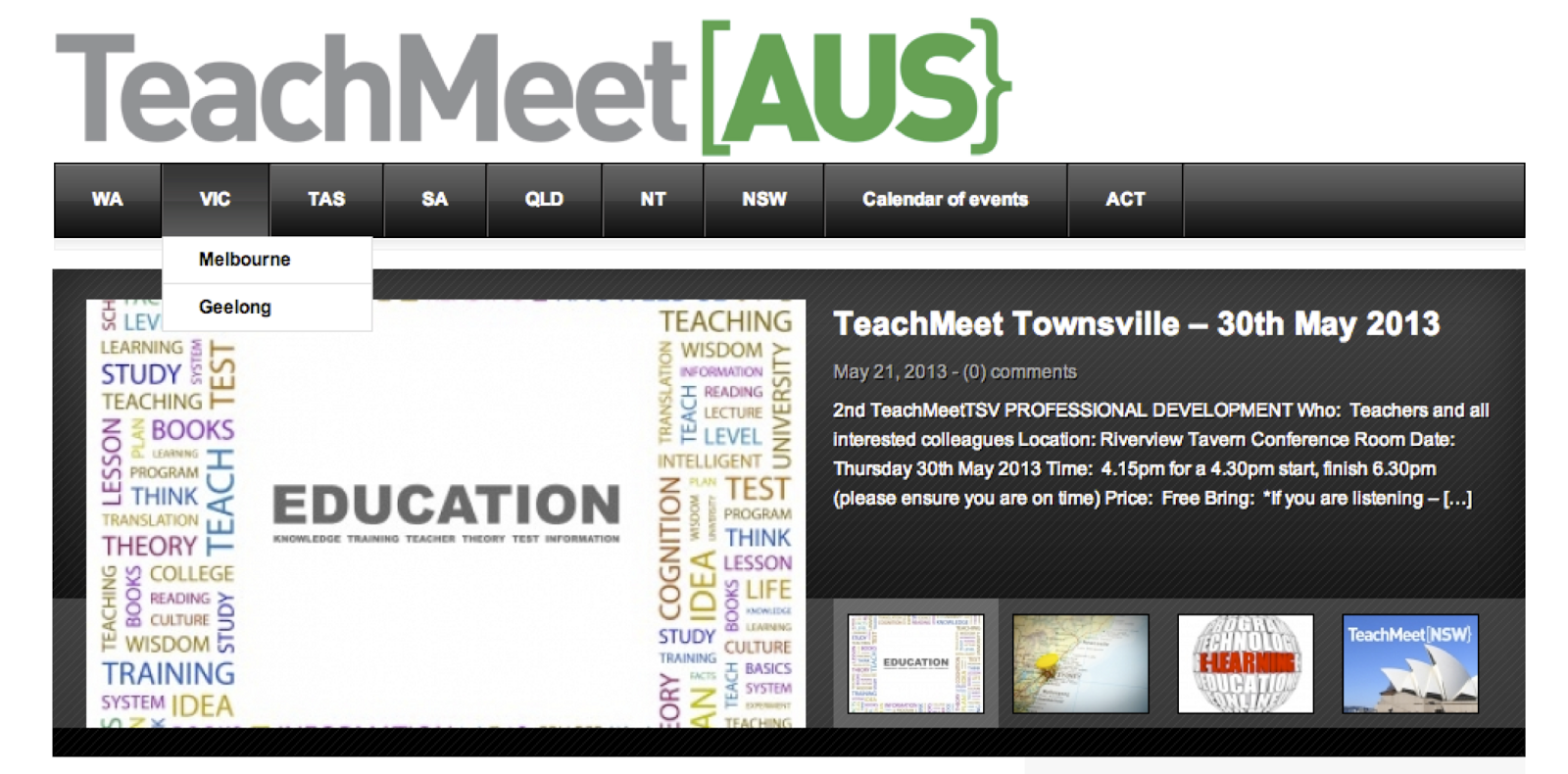
Find out all about TeachMeets across Australia at www.teachmeet.net. Taking Victoria as an example, we can see there are TeachMeets in Melbourne and Geelong. However, if you live in Shepparton, don't fret, simply find a venue in or near Shepparton and the team (via the website) will help you get started.

#11 - Other Ways of Linking with Fellow Teachers


As the only Spanish teacher in our cluster of 17 schools, my colleague Bettina might have been somewhat isolated. However, although working in southwest Sydney, she is now collaborating and sharing with Spanish teachers all over the world, particularly from the USA, via Pinterest. Consequently, she can cherry pick resources easily for the benefit of her students.

#12 - Twitter Conversations


As already mentioned, teachers need not feel isolated as they can now tap into thousands of expert and similarly specialised teachers via Twitter. One way to find specialist colleagues is via 'hash tags', some examples of which are listed here. These allow for subject based conversations that can be searched for easily. The list on the left shows global conversations. The list on the right shows Australian hash tags. In both cases these conversations are sometimes organised for specific times in the week. Of course #CEODECAISBFF is a bit of a tongue-in-cheek hash tag a bunch of us use when we collaborate cross-sectorially in the face of traditional barriers.

#13 - Between Teachers and Students
Marking by Pkabz, on Flickr
Creative Commons Attribution-Noncommercial-No Derivative Works 2.0 Generic License  by  Pkabz 
Some of the barriers between teachers and students are simply down to our work processes. Traditionally, a teacher collects in the students' books, takes them home on a weekend in Coles or Woolies plastic bags, possibly doesn't get around to marking them due to the busyness of weekend family life, invents an excuse on the drive back into work, does the walk of shame out of the car park carrying the books, with the students asking "have you marked them yet?" It doesn't have to be this way.

#14 - Anytime, Anywhere


By using online tools like Edmodo and Google Docs, teachers can access, feedback and mark students' work anytime, anywhere (thanks to Chris Leonardi and Jenny Symington for the screenshots). Teachers can be marking in class, out of class or at home, whichever suits them. I've even heard of one guy feeding back on Edmodo in the supermarket whilst waiting for his partner to choose which balsamic vinegar to purchase! A detailed video on such strategies by Charles Myer can be found here. In a great blog post by Robie Jayawardhana he talks about getting students to hand in or share tasks with teachers at the beginning rather than on the due date. That way teachers can offer feedback throughout the whole process and hence the students understand how they are progressing rather than finding out after the fact when it is too late.

#15 - Engage Me or Enrage Me
Low-tech texting . . . by jonmott, on FlickrStudents have never had barriers between them regarding technology, they have always texted, chatted and Facebooked since these technologies existed. However, teachers, schools and systems have been the ones that created the barriers between the students, such as banning mobile phones and making students sit in rows, potentially impacting on their collaboration. The thing is, students have always chatted at the back of the classroom, played games (albeit hangman in the back of their book) and bullied. These are behaviours due to disengagement and more. When they occur as online chat, MMOs or cyberbullying we should not be demonising the technology, rather, dealing with the underlying behaviours and perhaps the classroom activities. As a colleague of mine said "engage me or enrage me!"
Creative Commons Attribution-Noncommercial-Share Alike 2.0 Generic License  by  jonmott 

#16, #17 - Global Citizenship
These slides were videos from a school in southwest Sydney and a school from China (thanks again to Jenny Symington). Some of the barriers faced by students and teachers are simply down to distance, particularly when it comes to collaborating with schools elsewhere in Australia and especially around the world. However, technologies like Skype in the Classroom and online sharing through things like Dropbox and Google Drive have removed most of these barriers. In the first video, the students from Sydney acted out the story of Cinderella. They then sent the video footage over, where the Chinese students overlay the audio, in particular the dialogue, as part of their study of English. The Chinese students then shared back the finished product which was very funny and a great exercise all round.

In the second video, the Chinese students sent over footage of them playing hide-and-seek around their homes. What was particularly interesting for the students from southwest Sydney (a low socio-economic area) was how salubrious the homes were of the upper-middle class in China. This was a real lesson in global citizenship.

#18 - Final Slide
Augmented Reality by turkletom, on Flickr
Creative Commons Attribution 2.0 Generic License  by  turkletom 
A fantastic augmented reality pic to prove the point that if students aren't engaged they will find very creative ways to use their technology instead. Combined with this picture was the quote, often (though not definitively) attributed to Rabindranath Tagore:

"Do not confine your children to your own learning, 
for they were born in another time"


Friday, April 26, 2013

CoCo Seminar - The Digital Education Revolution: initial data analysis of teacher and student reported use of laptops in year 10 science

After the publication of my first paper, I was humbled to be asked to present my work as part of the CoCo Seminar Series at the University of Sydney. My seminar covered the background of the Australian Digital Education Revolution, how it was implemented by the schools I work with, the methodology and results of my first paper, the methodology and results of my second paper (in press) and my current research. Below is the prezi from the presentation and below that is an explanation of each 'slide'. Any feedback or discussion would be greatly appreciated. You can also listen to and watch the actual webcast of the seminar. 


Slide 1 - my ever present microscope graphic (courtesy of Balázs Turai) with tinyurl link in homage to the diggers of Kokoda on the eve of ANZAC day (CoCoDER was already taken!).

Slide 2 - 7.30 Report from 4th Dec 2007 featuring Kevin Rudd, Mark Pesce and principals discussing the DER (post-election). Nice quote from Pesce that providing every student with a device will force the issue with teachers, policy makers and curriculum design.

Slide 3 - A Digital Education Revolution policy document (Rudd, Smith & Conroy, 2007 (pre-election)

Slide 4 - Melbourne Declaration (MCEETYA, 2008)

Slide 5 - back in 2008 I moved from being a Physics teacher in one school  to eLearning Adviser to many schools, right at the outset of the DER. As such I had Principals, Consultants and Directors asking me what would happen to their exam results now every student would have a laptop? My boss said that sounded like a PhD thesis. At the same time I was offered postgraduate study with the Sydney University Physics Education Research  (SUPER) group following my work with them developing an interactive Thomson's Experiment for HSC Physics as part of the Australian Multimedia for Physics Students (AMPS) program. Accordingly I applied to research the impact of the DER in CEO Sydney through SUPER.

Slide 6 - originally, the main phrase banded around was the National Secondary School Computer Fund (NSSCF) rather than the DER, looking to move to a 1:1 computer to student ratio. There were to be two rounds, 1 & 2, beginning in 2008 and 2009 respectively, operating for 4 years each. However, due to negotiations between DETNSW and the federal government, Round 2 was pushed back to later in 2009 and became Round 2.1.

Slide 7 - CEO Sydney got involved straight away, accessing Round 1 funding for half of its secondary schools and Round 2(.1) funding for the other half. Every year 9 student was provided with a Federally funded Macbook or HP laptop. The schools had to bite the bullet and find funds (not budgeted for) to provided the teachers with the same laptops. CEO Sydney had to foot the bill for wireless infrastructure and tech support (though the DETNSW negotiations may have retrospectively covered this). These devices were issued to every Year 9 student over 4 years to be used until the end of Year 12. As such, some will still be in use until 2015, though no new DER devices have been issued since 2012.

Two unique epochs occurred in 2009 and 2011 where, due to only half of the students receiving laptops in 2008, we had a situation where half of the School Certificate candidature in 2009 and again for the HSC candidature in 2011 had been schooled with 1:1 laptops and half without. These epochs represented unique, never to be repeated, dichotomous scenarios to compare students with laptops to those without. Unfortunately, I was unable to begin my research in 2008/2009 (due to not being Australian enough as a then Temporary Resident!). However, after Permanency (and subsequently  Citizenship) I started in July 2010, and thus was able to capture the 2010 data and importantly the 2011 dichotomous HSC epoch data.

Slide 8 - Visible Learning (Hattie, 2009). Most studies have historically compared classes with and without technology and not different ways of learning with technology. We are investigating both.

Slide 9 - Choosing the Wrong Drivers for Whole System Reform (Fullan, 2011). "Pedagogically vapid" is a great phrase. The full statement is important as it emphasises that student performance is about teaching and learning, not the tech. (Fullan was relatively technophobic up to 2011. However, from 2012, in 'Stratosphere', he sees the opportunities technology potentially offers to teaching and learning).

Slide 10 - Laptops for Teachers: Practices and Possibilities (Cowie et al, 2011) - a more positive quote alluding to the new opportunities potentially provided to teaching and learning with laptops.


Slide 11 - The 3 papers so far from DECNSW on DERNSW by Sarah Howard et al from the University of Wollongong. (I envy the time and hence efficiency with which Sarah can work - my 2010 data analyses are appearing in 2013...). Peter Goodyear who leads the USyd Sciences and Technologies of Learning (STL) network and invited me to speak at CoCo was instrumental in setting up the DERNSW evaluation program and is a mentor to Sarah Howard. 


Slide 12 - The 16 secondary schools I work with and surveyed in South-West Sydney and the Shire.


Slide 13 - School Profiles - quite a spread in SES and ESL, all non-selective.


Slide 14 - Response Rates - very nice :) It helps having a relationship with the schools to encourage participation. Anonymisation of data and an obsession with objectivity will ensure no bias (the results published so far demonstrate this, I want to tell an honest story not butter up my colleagues with faux research). 


Slide 15 - First paper published thus far, second one pending. Results of both discussed below.


Slide 16 - Some questions paraphrasing those in the first paper.


Slide 17 - Questionnaire Tool (using Google Doc Forms)


Slide 18 - Bubble Diagrams for 3 teachers in the same department - 2 very similar and well aligned to their students, one very different and quite misaligned.


Slide 19 - Misalignment Index discussed with results


Slide 20 - Graph of Misalignment Index versus average Likert response for all teachers (split as Round 1 (2 years' experience) and Round 2 (1 year's experience)). The spread and trend are very similar for both groups. Those with higher average Likert responses had lower MI i.e. teachers utilsing and expecting greater use of laptops were more highly aligned with their students i.e. the students follow suit.


Slide 21 - Graphs for Student v Teacher responses for the 4 questions. Greater alignment between teacher expectation of laptop use in class/homework and student reported use (bottom two graphs) than between teacher practices of bringing their laptop to school/class and student practices (top two graphs).


Slide 22 - Empirical Alignment Graph - along with the Misalignment Index, the Empirical Alignment Graph could be used by any researcher when comparing teacher responses/activities with student responses/activities. Do you agree?


Slide 23 - Second paper 'in press' - some of the questions discussed.


Slide 24 - Bloom's Digital Taxonomy (reproduced with permission from Andrew Churches - thanks Andrew!)


Slide 25 - Questionnaire Tool (again using Google Doc Forms)


Slide 26 - Frequencies of use for all applications for teachers and students - note the disparity for Simulations in particular.


Slide 27 - Frequencies of use for 3 most enjoyed - note how students out report teachers for blogging, video editing and podcasting (higher order activities)


Slide 28 - Frequencies of use for 3 used most often - word processing, internet research (googling) and electronic text book reported in that order by both teachers and students (usually low order activities)


Slide 29 - Summary of Findings - note, though few students experience simulations, those that do really enjoy them.


Slide 30 - Summary of Findings continued - note issues with BoS. However, in all of these results it is very important to note that this data is from 2010, only one or two years into using 1:1 laptops for these teachers. Three years on from that the classrooms should look quite different (some researchers will have to investigate :)


Slide 31 - Quote from Halverson and Smith (2009) - a great quote highlighting that in some classrooms/schools/systems technology can be manipulated to simply maintain the status quo.


Slide 32 - Current Research - overview of current analysis of 2011 HSC dichotomous data, directly relating to the student performance (dependent variable).


Slide 33 - Whetting people's appetites with the early results - we have significance and correlation, but not saying what :)


Slide 34 - References for this presentation, many more in the papers.


Slide 35 - Acknowledgements - have Ethics Approval form CEO Syd and USyd and greatly appreciate  the participation and openness from the teachers and students!


Slide 36 - love the quote attributed (though not definitely) to Tagore and the augmented reality pic from turkletom.


With the second paper to be published soon there will be far more detail for readers to cogitate if they so wish. Any dialogue/feedback would be greatly appreciated. 


For me, the highlight of presenting at CoCo was the discussion that ensued during the seminar (and has continued subsequently) with the excellent researchers, educators and student teachers that I met. Many thanks to Peter Goodyear for the invitation, Pati Paez and Maryam Khosronejad for the organising and Martin Parisio for the webcasting.

Monday, April 8, 2013

Deep Analytical Thinking

Recently I was asked to run a workshop on 'Deep Analytical Thinking'. This was essentially a session on Critical Thinking and Higher Order Thinking Skills. The primary remit was to get teachers thinking about what it is they are asking of their students, particularly in assessments. Are they giving students the opportunities and challenges of accessing higher order thinking skills?

Working within the New South Wales Board of Studies (but relevant everywhere) it is particularly important for teachers to know and understand the 'verbs' asked of students in the syllabus, exams and consequently, the assessments the teachers write themselves.

This workshop engaged the teachers in a deep analytical thinking task (whilst getting them to collaborate in a Google Doc); tested their knowledge of the verbs in a fun quiz format (demonstrating the power of Google Doc Forms and Flubaroo script); demonstrated the merit in using unique stimulus data e.g. from http://www.gapminder.org/, thus ultimately allowing for open book/laptop, non-googlable  exams; and discussed Bloom's Taxonomy and Bloom's Digital Taxonomy.

Here is the Prezi, enjoy: