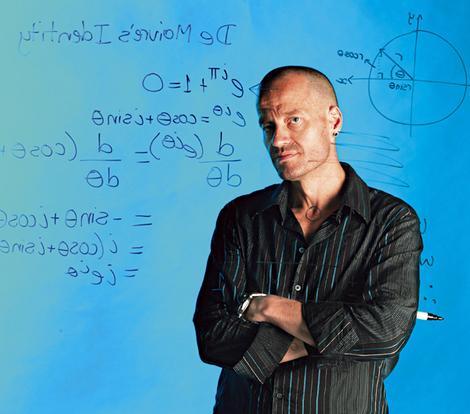
Below is a podcast I recorded for the students at ACU regarding eLearning in education and its future trajectory. Also below is a list of the resources I refer to plus some others that may be of use.
Thanks to an impromptu Google Alert I learnt that the recording of my presentation at TM Edutech (as described in this blog post) actually appeared in the TER Podcast this week. Many thanks to Cameron Malcher for recording and running the excellent TER Podcast (this episode is particularly interesting :-)
The original recording can be found here and also below. My section kicks in at 34:25 and runs for 11 minutes (kind of broke the TeachMeet limit of 7 minutes...oops...). All credits to TER Podcast and thanks for allowing it to be embedded.
The other week I had the pleasure of attending the inaugural Institute of Physics NSW Physics in the Pub bash in Sydney, hosted by +Phil Dooley. It was an excellent night of presentations (8 minutes each, TeachMeet-style), all of which were very informative and some also very entertaining, musical and humorous (check out Physics Hacks by Chris Stewart - very funny (bad language warning)). The networking was also top notch.
My contribution was 'iPeed on the iPad: Physics for Pre-schoolers'. Essentially, I demonstrated how a pre-schooler could have fun (learning physics at the same time) on the iPad using such apps as Planets and Universe Splitter. A recording of my presentation can be viewed below. Many thanks to Phil for organising, hosting and entertaining, Boris and AIP NSW for supporting, Chris for also entertaining and cutting the videos and to Shane Hengst from UNSW - Physics Outreach Unit for the photos.
Below is the recent ABC Radio National broadcast of last year's ABC Splash Live event (previously described in this post). My presentation 'What does it mean to teach in a technology-rich world?' kicks in at about the 29 minute mark after some great work by Bron Stuckey and Dean Groom, and before Alice Leung's top draw presentation. The original recording and description can be found here on the Radio National site. Many thanks to Kulja at @ABCSplash.
Earlier this month I had the fortune to attend the Edutech conference in Brisbane. It was a great event with some excellent speakers, Sugata Mitra being the best (what a way to start a conference!). However, the best thing for me was the networking, getting to know some of my up-and-coming colleagues in our delegation, and of course the Edutech TeachMeet.
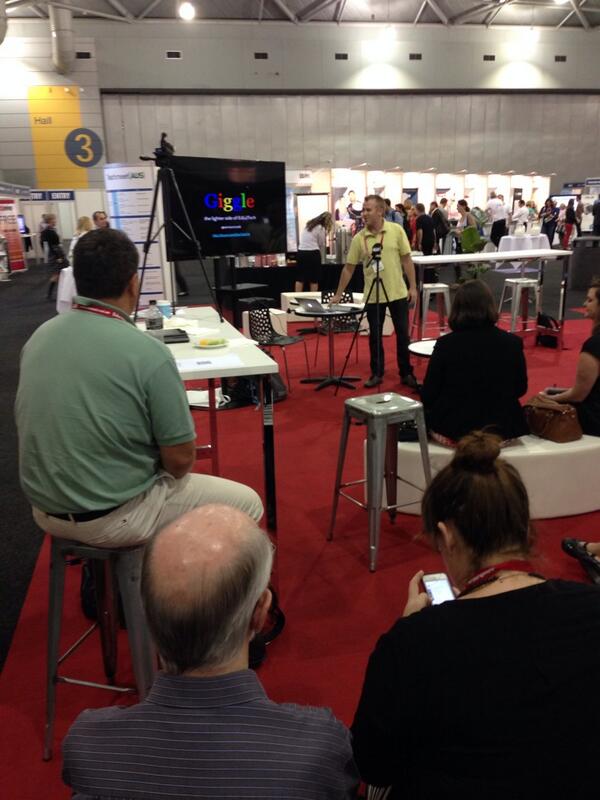
Thanks to some typically hard and selfless work by +Matt Esterman, working with the event organisers not least Jon Chivers, a great space was arranged in the main Expo for four mini-TeachMeet sessions. The first session was kicked off by the ever youthful grandfather of TeachMeets +Ewan McIntosh, with 16 presenters all up over the two days. My presentation 'Giggle - the Lighter Side of Ed(u)Tech' was a major expansion on 'Giggle the funny side of Edtech' from TM ACU with references to 'Giggle (and Hoot) - the funny pre-school side of Edtech' from TM Google (essentially third time lucky). The slides can be found below. Most of them are self-explanatory. A podcast of my presentation also appears here on the TER podcast (thanks @capitan_typo).
A few weeks back I presented at TeachMeet Google held at Google's very funky Sydney headquarters. Three days before the event my wife informed me that she had parent-teacher night that evening i.e. I had the kids! This posed a minor problem, how was was I going to deliver my incredibly witty presentation 'Giggle - the funny side of Edtech' with Mr4 and Mr2 in tow? As a testament to the character of @leannecameron (or her sense of anarchy) she agreed to let me bring both boys along. Due to the tight security at Google's headquarters I needed to provide all of their details. In so doing each of them had their own Google TeachMeet name tag which was quite cute. Given that I had two pre-schoolers with me, in a moment of idealism (or stupidity) I decided to change my presentation to include them, plumbing for 'Giggle (and Hoot) - the funny pre-school side of Edtech' (in reference to the Aussie kids show Giggle and Hoot).
All I had to do was keep them occupied and quiet for 50 minutes until our slot. At first this seemed too easy with Mr2 asleep and Mr4 preoccupied with the charms of a very helpful and selfless +annajones. However, Mr2 awoke almost immediately...
As his sonic furore started to gear up I panicked. Instead of grabbing an emergency chuppa chups I grabbed the iPad and played Peppa Pig on YouTube, moving us to just outside the door. The good thing was he quietened down and before my very eyes taught himself how to find and launch YouTube (previous he would only press on apps, then the home button, then another app, and so on). On the bad side he became addicted to the iPad.
It was about this time that our turn came. I grabbed the iPad from the grasp of Mr2 and marched him and Mr4 to the stage. Cue massive tantrums to get the iPad back with screams of "PEPPA! PEPPA!". Just after I set up my iPad on the lectern and had begun introducing ourselves Mr 2, still screaming "PEPPA!", tried to to jump up to the lectern, grabbing whatever wires he could almost wrecking Google's AV equipment!!! And so began our very quick presentation of 6 slides (see below).
#1 - Title (including Hoot the Owl)
#2 - In describing Mr4's experience of technology I asked him how he spoke to Granny and Grandad every weekend on the other side of the world. His very cute answer was "On the 'puter"
#3 - I then asked him what his favourite game was ("Zombies"); what the sun were for and why he had to collect them. His sequence of answers was a great example of GBL problem solving.
#4 - Getting a bit more conventional in the educational use of technology I asked Mr4 to explain the Planets app and how we can see it is daytime in England when it is nighttime in Australia.
#5 - Rounding off Mr4's experience of technology I showed a talking animals video from the BBC (one of his favourites). The funny thing was the audio didn't work at first so Mr4 literally impersonated the marmots saying "Alan! Alan! Alan! No, Steve! Steve! Steve". Then the audio kicked in, much to his appreciation. In time, I want to use films like this to get him to improvise. As it was, he essentially did just that on the night.
#6 - All the while I'd been indulging in Mr4, Mr2 was roaming around looking for Peppa. It was only fair therefore to include him. Until the overindulgence earlier with Peppa Pig his main experience of technology had been listening and dancing to songs such as Rockabye Bear by The Wiggles. Consequently I played this and he was over the moon, particularly being able to view it on the big screen. He treated everyone to a little dance and the whole audience joined in with the clapping and and actions.
By sheer luck it worked out well in the end and was quite funny to boot. Many, many thanks go out to Leanne for her organisation and understanding, Anna for her caring charm and +Sally-Ann Williams and +Marie Efstathiou for allowing us to use such an excellent venue
In this social media/mobile learning age, what better way to get students to share their enjoyment of Science than allowing them to take Science Selfies during their experiments. These can be shared with their parents, teachers and each other.
And a challenge for all adult readers - we are forever trying to raise the profile of Science - lets get actual scientists posting Science Selfies on Twitter and Instagram #scienceselfies! (I thought this was an original idea but there are loads out there already. At least this is good for Science :)
There are thousands of iPad apps being flogged for Science education but what are the best ways to use iPads to compliment Science pedagogy. To me, the best and most obvious way is to use iPads or other mobile devices in Science experiments and inquiry. Here are some suggestions:
1. Get the students to record the teacher demonstrating an experiment before they attempt it themselves. That way they can listen back and make sure they haven't missed anything whilst not wasting time writing. Revisiting the video for homework or in later classes the students can use it to help them to formally write up the experimental method and for various literacy exercises.
2. Get students to take photos of the teacher's experimental apparatus plus any diagrams on the board. Again, why waste precious class time copying them down.
3. Most importantly, students can video themselves performing experiments, orating their procedure and capturing their results as they happen. This is particularly empowering to students with poor writing skills. And seriously, does every experiment have to written up formally? Why not a video blog instead?
4. Use the stopwatch facility for the plethora of experiments that require measuring time. (Quick anecdote - years ago I would forever be forgetting to order the stopwatches for experiments and was too afraid to go to the lab technician late. Instead I would ask the students to use the stopwatches on their old clunky mobile phones I knew they had hidden on their person. It was breaking school rules, but to benefit learning. This was the beginning of mobile learning).
This week I was again fortunate enough to run some Science lessons for some Primary students from St Felix Primary School using the Science labs at La Salle College next door. Rather than simply blasting them with mad Science experiments (check out last year's fun: Bunsen Burners, Flame Tests and iPads with Years 4 & 5), the Principal Lisa Harbrow and myself were determined that any experiments would compliment the students' units of study. Accordingly, I decided to do some electrolysis with Year 5 who were studying 'Gold' and thermodynamics with Year 6 who were studying 'Antarctica'.
Y11/12 Chemistry with Y5
Year 5 had been learning about the gold rushes of California and Australia, alluvial gold and how to pan for it. Now the chemistry of gold is not particularly exciting, but the extraction of other metals is! Consequently, I decided to get the students to perform an electrolysis experiment to electroplate 5¢ coins with copper extracted from copper sulphate solution. Now this is Year 11/12 Chemistry, certainly requiring secondary schools equipment. However, we were fortunate enough to have access to a lab at La Salle College next door thanks to Principal Mick Egan plus the most amazing lab technician in the form of Margaret Croucher (who is also Chairperson of ASETNSW - Association of Science Education Technicians, and treasurer of SETA - Science Education Technicians Australia). With this quality of support we were able to sort out the appropriate WHS for Y5 students to perform such an experiment.
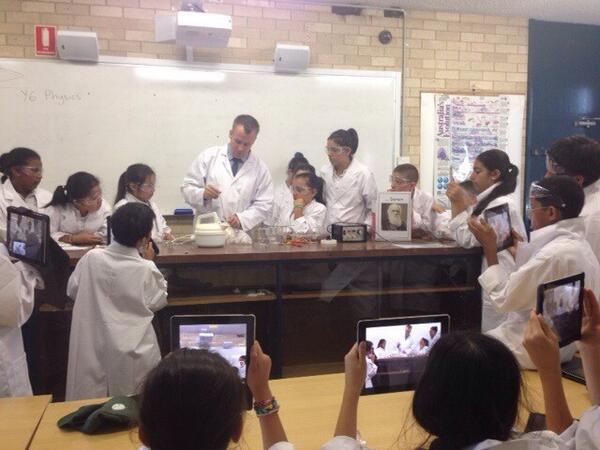
No paper instructions or worksheets were issued. Instead, students recorded myself performing the procedure using their school's iPads, photographed the equipment and also diagrams on the board to assist them in carrying out the experiment themselves. More importantly they filmed themselves performing the experiment. (In follow up lessons back at Primary school the students would be using the video footage to help write up their experiment as a literacy activity). I also demonstrated the electrolysis of water using a Hofmann Voltameter, igniting the hydrogen produced for a nice squeaky pop! And, with a bit of time spare at the end of a great Science lesson, what more motivating activity could we do than take Science Selfies!
Y9/10 Physics with Y6
In studying Antartica, Year 6 learnt in particular about the features of animals that lived there plus the issues of global warming with regard to sea level rises. These two aspects leant themselves perfectly to some experiments more appropriate to the Year 9 and 10 syllabus. To build on what the students had learnt about the use of blubber and layers of feathers in various Antarctic fauna (plus fur in Arctic fauna) we performed the classic insulation experiment using warm water (not hot water due to being Year 6), soft drink cans as calorimeters, thermometers and various materials for insulation to compare between the materials. This was a wonderful scientific exercise in understanding controlled, independent and dependent variables. Again the iPads were used in a similar way to before (including selfies!) plus this time as stopwatches too.
Whilst this experiment was taking place the students had another experiment running. Now this is an experiment I made up. Taking 2 beakers we filled one with 100ml of water and placed an ice cube on a gauze across the top of the beaker. The other we also filled with 100ml water but this time added an ice cube and poured out a small amount of water to bring it back to 100ml. The point of this experiment was to highlight the important difference between glaciers (ice cube on the gauze) melting and icebergs (ice cube in the water) melting. Many people think that both cause sea levels to rise. However of course, when an iceberg (or floating ice cube) melts the water level stays the same due to Archimedes Principle. When a glacier on land (ice cube on a gauze) melts then water levels do rise due to the input of additional water - obvious when you think about it.
Most importantly with these thermodynamics experiments, any Primary school could perform them, they need only purchase thermometers, plastic beakers/measuring cylinders/jugs and basic materials such as wool, cotton wool, aluminium foil, bubble wrap etc.
Authentic Learning in Science
IMHO this is authentic learning in Science. The students cross-curricular units of study determined the experiments. The learning was in real world contexts. Just because the students are in Primary school there is no reason why they shouldn't engage in higher-order scientific inquiry and experimentation. In fact they loved the fact that they were performing senior Science experiments. Many thanks go out to Lisa, Mick and Margaret plus the Primary teachers including Maree Elchaar and Margaret Stelmach, and of course the wonderful Year 5 and 6 students! Further images and audio explaining this adventure can be viewed here.
Recently I ran a twilight workshop for beginning teachers. The main purpose was to educate the new teachers on their rights and responsibilities when using technology in school (and home). Referring to our acceptable use and social media policies I highlighted that as long as they know that 'Big Brother' is watching then they should behave accordingly. With regard to social media we discussed the challenges facing teachers, young teachers in particular, but also the opportunities.
Below are the slides that I used. They are self-explanatory (although I must point out that I didn't realise the pun I gave slide 12 until later :)
I was due to attend and present at the ACU TeachMeet but was unfortunately unable to make it yet again :( However, below is a short video I made in lieu of me presenting. Well done to Leanne Cameron and Miriam Tanti for hosting yet another great TeachMeet at ACU! The back-channel can be found at #TMACU.
Recently, as a favour to a local primary principal (and to fulfil my own need to teach some science), I ran a day of science lessons for Years 4 and 5. As a wonderful example of cooperation, the neighbouring secondary school had provided the primary school with access to a science lab for the year. Having the unique opportunity to use secondary science equipment with primary students I set about designing a fun and worthwhile hour to be repeated with the four classes.
Now primary students are always itching to study science once they get to secondary (although this enthusiasm often wanes by the end of Year 7...), and what they want to use most of all are Bunsen burners. To this end, I chose to:
teach the students the parts of a Bunsen and their function
get them to light a Bunsen safely
perform flame tests on various metal salts.
The preparation was made possible by the wonderful lab technician at the secondary school, Margaret Croucher (who is also Chairperson of ASETNSW - Association of Science Education Technicians, and treasurer of SETA - Science Education Technicians Australia). With my secondary chauvinism it didn't occur to me that primary students might not be allowed to participate in the experiments. Thankfully Margaret came to the rescue, and after a lot of negotiation with the Health and Safety people we established that although we couldn't use solid salts we could use 0.1M solutions soaked into paddle pop sticks.
When the students arrived, much to their delight, we got them to wear lab coats and safety goggles. We then discussed the parts of the Bunsen, their function, how to light a flame and the different types of flame. Then the moment of truth - every student got to light a Bunsen. [Aside - during the introduction I pointed out that the box of equipment for every group had a famous scientist on it. However, of the 10 scientists only 2 were female (Marie Curie and Rosalind Franklin), why? One boy tried to explain that men were smarter and was quickly rebuked. After a several hints (surprisingly many) we extracted that historically girls and women weren't given the same access to education. However, I challenged both the girls and boys to capitalise on their fortune in accessing high quality education in a country of opportunities such that in 100 years they might be the famous scientists in a 5/5 split).]
Once every student had successfully lit the Bunsen I brought them back together to demonstrate how to perform a flame test. Subsequently, they each got to perform a flame test with a different solution within their groups, filming proceedings on their iPads and recording their results. Chuffed with the timing of the lesson I brought them together to go through the results.
This was a wonderful day that couldn't have happened without the vision of Lisa Harbrow, Principal of St Felix Primary School, the support of Mick Egan, Principal of La Salle College, the Y4&5 class teachers, particularly Maree Elchaar and Ashley Azzopardi, Ritz Balzarno - Science Coordinator at La Salle, and of course Margaret Croucher. As a follow up activity, Ashley got her students to blog about their experiences. Please see below, it is very cute as they practise their letter writing to each other, signing off sincerely. Please do add you own comments on their blog to feedback to the students. Well done Year 4 & 5!!!
If we are to prepare students (and for that matter, teachers) for their future, what will the future of education look like? What new technologies are on the horizon and which ones will become de rigeur? Are there ‘futuristic’ technologies already being used successfully in schools? Drawing on the latest research, this presentation will look at the future directions of technology in education, inside and outside the classroom.
Future opportunities and how they might be capitalised upon e.g. teacher collaboration will be discussed. Examples of the innovative use of contemporary technologies in teaching and learning, K-12, will be demonstrated. The emerging challenges surrounding technology that are facing education leaders, such as professional development, accessibility, evolving societal pressures, and how they might be overcome will also be discussed. As the saying goes, “do not confine your children to your own learning, for they were born in another time”
Slide 1 - My ever present opening slide. What is wrong with this slide? Nope, it's not the kid with the slate (get it! :) the image is back to front, the writing on the board goes from right to left. Slide 2 - Background: Senior eLearning Adviser to 17 secondary schools in southwest Sydney and the Shire. Slide 3 - It is important that this whole presentation is ground in the latest research. The most obvious and important choice for future technologies in education is of course the annual Horizon Report. Slides 4&5 - The 2013 DEAG Report, commissioned by the Australian Government, makes some important recommendations to prepare schools for the future of learning. Slide 6 - With the end of the Federal funding in the DER we must not lose the momentum created thanks to the embedding of so much technology in schools. Equally, we must learn from the various evaluations of the DER by DEEWR, DECNSW and (as a shameless bit of self-promotion) my first and second papers. Slide 7 - Before Google, the teachers were the sole bastions of knowledge. Post-Google, students can find out simple facts using simple Google searches, Wikipedia (copying, pasting and plagiarising) and even acquire skills e.g. learning the guitar via YouTube, all on mobile phones that are banned in most classrooms. From about 2016 according to the Horizon Reports (or 2020 according to Wikipedia), the Semantic Web will be all-pervasive with a far more personalised online experience. Slide 8 - Consider the new NSW Board of Studies Syllabus for Australian Curriculum History. If we only ask simple questions of facts, students can answer these in seconds.
Slide 9 - However, if we ask deeper, higher-order, personal, subjective questions students will not be able to google the answers.
Slide 10 - Ask Ungoogleable Questions (a phrase I heard from @ewanmcintosh). I am not saying Google is bad, but in its simple form it is pretty low-order (as shown in Bloom's Digital Taxonomy). We need to offer students higher-order questions and opportunities. At the very least we should extol the virtues of 'Advanced' Google searches.
Slide 11 - Whether within or outside the classroom, students can collaborate with their teachers and each other, importantly receiving immediate and regular feedback through cloud computing apps like Google Docs and Edmodo.
Slide 12 - Teacher Collaboration: teachers can also take advantage of these technologies and collaborate too, not least with collaborative programming for the Australian Curriculum using Google Docs.
Slide 13 - Teachers don't need to rely solely on formal professional development or the collegiality of the teachers they work with. Through TeachMeets and the networks that ensue, teachers can be proactive in their own professional learning in a fun, informal and highly beneficial environment. (Check out http://www.teachmeet.net/what-is-a-teachmeet/).
Slide 14 - Quick plug for all English and Drama teachers, K-12, to attend the English Australian Curriculum TeachMeet at the State Theatre Company. Should be a great Friday night out! See http://tmsydney.wikispaces.com/TeachMeet+AC+English for details.
Slide 15 - Hand in glove with TeachMeets is networking with fellow educators through Twitter. On Twitter there is a whole variety of awesome teachers willing to collaborate, share resources, converse with and even mentor. On this slide is an all too brief (and nepotistic) list of some of the people I collaborate with and learn from. They represent educators from government, systemic Catholic and independent schools, interstate and overseas.
Slide 16 - Teachers need not feel isolated as they can now tap into thousands of expert and similarly specialised teachers via Twitter. One way to find specialist colleagues is via 'hash tags' on Twitter, some examples of which are listed here. These allow for subject based conversations that can be searched for easily. The list on the left shows global conversations. The list on the right shows Australian hash tags. In both cases these conversations are sometimes organised for specific times in the week.
Slide 17 - A couple of Prezis to help teachers and principals with Twitter and understanding it's power for collaboration and online presence.
Slide 18 - Other ways teachers are collaborating include using things like Pinterest to find teachers from the same subject area to follow, post and share resources with. In the example shown, my colleague Bettina, from All Saints Girls Liverpool, is a Spanish teacher isolated in a local network of Italian teachers. She uses Pinterest to find and connect with other Spanish teachers form North America. Slide 19 - With most, if not all students having a mobile phone (check out the ABS stats), why are they banned from most schools and classrooms? Now that the Digital Education Revolution has ended and the Federal funding stopped, how are we going to maintain the momentum of embedded technology in the classroom. One answer is to let the students bring their own mobile devices. There are solutions to the issues of cost and equity, not least schools supporting the minority of Australian families that cannot afford any device. There are also technical solutions for the techies. Several schools are running pilots of BYOD, including some I work with in low SES areas, plus @aliceleung's school, again in a low SES area. Slide 20 - A great image that passed my way that sums up the power of mobile devices and their underutilisation.
Slide 21 - A lot of people do not realise that many students already have programming skills and enjoy coding. Under the guidance of my colleague Jason at Good Samaritan College Hinchinbrook, there are Year 10 girls and Year 11 boys writing literacy and numeracy apps respectively for the neighbouring primary school students. The older students are using the actual NSW Board of Studies syllabuses to create and differentiate the questions for the littlies. This is an amazing story - well done to Jason and students!
Slide 22 - Identified in the 2013 Horizon Report was the emergence of 3D Printing over the next four to five years. 3D printing uses computer-aided design (CAD) software combined with a plastic extrusion-like process to create tangible, three-dimensional objects. Despite the timeline suggested, it should be noted that several schools have all ready purchased and are using a 3D printer. For example, Clancy College in West Hoxton, is using its 3D printer to make topographical maps in Geography, molecular structures in Science, mobile phone cases in Design and isoloc hybrid joints in Timber only possible in CAD.
Slide 23 - Game-Based Learning: why not use Angry Birds to teach projectile motion as this pic from @aliceleung's classroom shows? There is also a great blog post by Wired on this.
Slide 24 - Taking GBL to the extreme, Michael from Freeman College Bonnyrigg is using WWE Wrestling on the XBox to teach literacy! The students have to write correct instructions on their moves and counter moves. Based on their writing the moves are then entered into the game to simulate the fight. As an incentive, a couple of students get to play at the end of every lesson.
Slides 25&26 - Global Citizenship: These slides were videos from All Saints Girls Liverpool and a school from China (thanks to Jenny from Liverpool). With Skype in the Classroom and online sharing through things like Dropbox and Google Drive, students from two different hemispheres can collaborate together. The Liverpool girls sent video footage to China of themselves acting out Cinderella. The Chinese students overlay the audio, in particular the dialogue, as part of their study of English. The Chinese students then shared back the finished product which was very funny and a great exercise all round.
In the second video, the Chinese students sent over footage of them playing hide-and-seek around their homes. What was particularly interesting for the students from southwest Sydney (a low socio-economic area) was how salubrious the homes were of the upper-middle class in China. This was a real lesson in global citizenship. It is important to note that this happened in 2011. With the Asian cross-curriculum priority in the Australian Curriculum from 2014, is this kind of collaboration happening in every Australian school? If not, why not?
Slide 27 - Getting into the more extreme predictions of what schools will look like in the future, Neil Selwyn of Monash University discusses in this article things such as smart drugs, haptic technology, robot teachers and moveable and modifiable schools.
Slide 28 - Spreading their bets, the OECD present 3 pairs of possible scenarios for schools in the future in this article. I am fearful of the first pair i.e. maintaining the status quo. There is a lot of research (including some of my own) plus plenty of anecdotal evidence, not least the proliferation of the industrial model of schools, that would suggest this may well be the case. Many educators will prefer one or both of the second pair 'Re-Schooling' which "would see major investments and widespread recognition for schools and their achievements". Futurists may prefer scenario 3a in 'De-Schooling' with "the abandonment of schools in favour of a multitude of learning networks". Capitalists may prefer 3b where "many new providers are stimulated to come into the learning market, encouraged by thoroughgoing reforms of funding structures, incentives and regulation".
Slide 29 - A great quote from Halverson and Smith (2009, p.52) warning of the institutional mindset in many schools and systems that manipulate new technologies to maintain the old paradigm and status quo:
“schools seemed to pick up on affordances that reinforced institutionalized priorities. Rather than opening up new opportunities to reframe how teachers teach and students learn, it seemed as though instructionalism bent technologies to extend existing pedagogical, curriculum delivery, and assessment practices”
Slide 30 - To the contrary, Weston and Bain (2010, p.14) highlight that technologies can be used as a catalyst for a paradigm shift in proactive schools:
“[technology] initiatives can be fertile ground for the creation of new-paradigm schools, schools that are self-organizing”
Slide 31 - The 13 references used (8 of which from 2013).
My ever present final slide: a fantastic augmented reality pic to prove the point that if students aren't engaged they will find very creative ways to use their technology instead. Combined with this picture was the quote, often (though not definitively) attributed to Rabindranath Tagore:
"Do not confine your children to your own learning, for they were born in another time"
I have been nervous about the publication of this paper as it is not necessarily a good news story. However, it goes without saying that I have to be objective and report the data as it appears. Here is the abstract (for the full article click on the link above):
This study examines the responses of 1245 science students and 47 science teachers from 14 Catholic high schools in Sydney, Australia, 2010. Two years into a 1:1 laptop program, the types of activities engaged in with laptops as self-reported by teachers and students are analysed. The activities are differentiated from lower- to higher-order using Bloom’s Digital Taxonomy. Though the shift has been to use pen and paper less and laptops more, it is found that the modal practice for students is the lower-order paradigm of note-taking and working from textbooks through electronic means by word processing and electronic textbooks, plus simple online searching. Students would like to engage in more higher-order activities such as blogging and video editing but these are not favoured by teachers. Datalogging and databases, despite being encouraged or even mandated by the Board of Studies NSW, are rare experiences. Most science teachers appear to use simulations but students do not report the same experience. Investment must be made in the professional development of teachers to empower and encourage them to integrate higher-order tasks and to capitalise on the opportunities offered by 1:1 laptops.
What is most important to highlight is that the findings are based on 2010 data. As systems/schools/teachers, we have to ask ourselves 'have we progressed from this baseline in the 3 years since?' (The next few papers will go some way to answering this).
Slide 1 - What is wrong with this slide? Nope, it's not the kid with the slate (get it! :) the image is back to front, the writing on the board goes from right to left. Slide 2 - Before Google, the teachers were the sole bastions of knowledge. Post-Google, students can find out simple facts using simple Google searches, Wikipedia (copying, pasting and plagiarising) and even acquire skills e.g. learning the guitar via YouTube, all on mobile phones that are banned in most classrooms. From about 2016 according to the Horizon Reports (or 2020 according to Wikipedia), the Semantic Web will be all-pervasive with a far more personalised online experience. Slide 3 - Consider the new NSW Board of Studies Syllabus for Australian Curriculum History. If we only ask simple questions of facts, students can answer these in seconds.
Slide 4 - However, if we ask deeper, personal, subjective questions students will not be able to google the answers.
Slide 5 - Ask Ungoogleable Questions (a phrase I heard from @ewanmcintosh). I am not saying Google is bad, but in its simple form it is pretty low-order. We need to offer students higher-order questions and opportunities. At the very least extol the virtues of 'Advanced' Google searches.
Slide 6 - In a techonology-rich classroom students can collaborate with their teachers and each other, importantly receiving immediate and regular feedback through apps like Google Docs and Edmodo.
Slide 7 - Teacher Collaboration: teachers can also take advantage of these technologies and collaborate too, not least with collaborative programming for the Australian Curriculum using Google Docs.
Slide 8 - Teachers don't need to rely solely on formal professional development or the collegiality of the teachers they work with. Through TeachMeets and the networks that ensue, teachers can be proactive in their own professional learning in a fun, informal and highly beneficial environment. (Check out http://www.teachmeet.net/what-is-a-teachmeet/).
Slide 9 - Quick plug for all English and Drama teachers, K-12, to attend the English Australian Curriculum TeachMeet at the State Theatre Company. Should be a great Friday night out! See http://tmsydney.wikispaces.com/TeachMeet+AC+English for details.
Slide 10 - Other ways teachers are collaborating include using things like Pinterest to find teachers from the same subject area to follow, post and share resources with. In the example shown, my colleague Bettina, from All Saints Girls Liverpool, is a Spanish teacher isolated in a local network of Italian teachers. She uses Pinterest to find and connect with other Spanish teachers form North America. Slide 11 - A quick plug for the great resources on ABC Splash. Slide 12 - An example of a great resource on ABC Splash - a video from Catalyst by my mate Derek Muller (of Veritasium YouTube Channel fame), alumnus of Sydney University Physics Education Research (SUPER). Slide 13 - With most, if not all students having a mobile phone (check out the ABS stats), why are they banned from most schools and classrooms? Now that the Digital Education Revolution has ended and the Federal funding stopped, how are we going to maintain the momentum of embedded technology in the classroom. One answer is to let the students bring their own mobile devices. There are solutions to the issues of cost and equity, not least schools supporting the minority of Australian families that cannot afford any device. There are also technical solutions for the techies. Several schools are running pilots of this including some I work with in low SES areas plus @aliceleung's school, again in a low SES area. Slide 14 - A lot of people do not realise that many students already have programming skills and enjoy coding. Under the guidance of my colleague Jason at Good Samaritan College Hinchinbrook, there are Year 10 girls and Year 11 boys writing literacy and numeracy apps respectively for the neighbouring primary school students. The older students are using the actual NSW Board of Studies syllabuses to create and differentiate the questions for the littlies. This is an amazing story - well done to Jason and students! Slide 15 - Game-Based Learning: why not use Angry Birds to teach projectile motion as this pic from @aliceleung's classroom shows? There is also a great blog post by Wired on this.
Slide 16 - Taking GBL to the extreme, Michael from Freeman College Bonnyrigg is using WWE Wrestling on the XBox to teach literacy! The students have to write correct instructions on their moves and counter moves. Based on their writing the moves are then entered into the game to simulate the fight. As an incentive, a couple of students get to play at the end of every lesson.
Slides 17, 18 - Global Citizenship: These slides were videos from All Saints Girls Liverpool and a school from China (thanks to Jenny from Liverpool). With Skype in the Classroom and online sharing through things like Dropbox and Google Drive, students from two different hemispheres can collaborate together. The Liverpool girls sent video footage to China of themselves acting out Cinderella. The Chinese students overlay the audio, in particular the dialogue, as part of their study of English. The Chinese students then shared back the finished product which was very funny and a great exercise all round.
In the second video, the Chinese students sent over footage of them playing hide-and-seek around their homes. What was particularly interesting for the students from southwest Sydney (a low socio-economic area) was how salubrious the homes were of the upper-middle class in China. This was a real lesson in global citizenship. Slide 19 - The resources I used. Slide 20 -
A fantastic augmented reality pic to prove the point that if students aren't engaged they will find very creative ways to use their technology instead. Combined with this picture was the quote, often (though not definitively) attributed to Rabindranath Tagore:
"Do not confine your children to your own learning, for they were born in another time"
Normally after I've presented at a conference I blog, simply to share my own presentation without necessarily commenting on the conference itself in much detail. However, in the case of ABC Splash Live, it is worthy of a post in its own right.
ABC Splash is a free online resource from the ABC to help support teachers, particularly with the advent of the Australian Curriculum. It is a very engaging resource, providing an ever increasing number of 'cutting-edge games, virtual worlds and immersive digital experiences'. Of particular use in these times of Australian Curriculum is ABC's partnership with Education Services Australia (ESA), thereby making readily available to teachers and students many of the learning objects from Scootle without requiring a Scootle login.
Anyway, back to the day: I was chuffed to get the gig at @heyjudeonline's recommendation (thanks Judy!). The agenda was very enticing. @AnnabelAstbury was an excellent MC and host. Proceedings began with Annabel interviewing @AdamBSpencer. Adam was very entertaining, not least highlighting the fact that being into maths, science and chess is cool!
Straight after the keynote interview was my presentation 'What does it mean to teach in a technology-rich world?'. It seemed to go pretty well (see next blog post for details). Next up was @aliceleung regarding the power of a back-channel in schools, both in the classroom and for example in staff meetings. It was great to segue into Alice's presentation having mentioned the power of TeachMeets and a PLN. Also, when discussing GBL I used Alice's famous example of utilising Angry Birds to learn projectile motion.
Following Alice was @jarruzza on the power of sharing knowledge in real time using tools such as Google Docs and Google Forms. By sheer coincidence, Jason and I both chose separate videos from ABC Splash on objects falling under gravity to meet our various ends. It was quite amusing when Jason suddenly jumped out of his seat to stop me from inadvertently steal his thunder. The crisis was averted and an uncanny further segue created.
After morning tea, @msdigifly shared some very interesting stories about four schools from across Australia (3 rural and 1 city) engaging in the 'Making the News' project. Sara was followed by Amy Walsh from PLC Armidale, one of the participating schools. The news reports from PLC told a fascinating story of the partnership between the community garden and the local 'fancy' restaurant. Finishing off the morning was @BeveridgeSue on the merits of video conferencing.
Kicking off the afternoon was @leejr from ESA sharing some of the learning objects and simulations in ABC Splash. Following Leanne was @berniehobbs presenting the brand spanking new GBL experience from ABC called Zoom. 'Zoom is a browser-based game primarily aimed at year 9 and 10 students to bring back the fun in science learning'. After Bernie was @BronSt on gamification of learning and 'hard fun' and 'flow'. ('Flow', the sensation gamers have when they are 'in the zone', sounded very much like the martials arts idea of 'mushin'). Last cab off the rank (and my personal highlight) was @Type217with 'Raising Gamer Kids'. As ever, Dean had a very irreverent, yet well informed and humourous manner of delivery, taking people out of their comfort zone with a mini-case study of Hit Girl. He also provided some practical advice around what makes gamer kids tick and how to raise them.
In conclusion, it was a great day. I truly feel this was a quality, free professional development opportunity provided by the ABC and I thank them sincerely, especially Katie and Annabel for their organisation. As ever at events like these the networking was fantastic. It was great to catch up again with Annabel, Alice, Sue, Bron and Dean and wonderful to meet Adam, Katie, Jason, Sara, Amy, Leanne and Bernie for the first time. In closing I leave you with a Storify of the back-channel from @steverwilkins and a great image Dean used to portray gamer kids.
Recently, my next door neighbour gave me Stasiland by Anna Funder to read. It is a very moving and oftentimes horrific account of life in East Germany after the Wall went up, under the the constant monitoring and manipulation of the Stasi, the GDR secret police. The reign of paranoia, fear, obedience and acquiescence was not fiction from George Orwell's 1984 but actually happened to real people from the 1950's to 1989. A constant feature throughout was the insidious way the Stasi endeavoured to break the spirit of the populace in a calculated fashion (a theme covered so often in fiction by e.g. Orwell and Pink Floyd (for a tenuous link see Peer Review, Peer Exposure)).
In the Notes on Sources at the end of the book, Funder reports that she later "found instructions to [Stasi] operatives on ways of crippling 'oppositional' people". The aims of these instructions were to:
develop apathy (in the subject)
achieve a situation in which in which his [/her] 'conflicts', whether of a social, personal, career, health or political kind are irresolvable
give rise to fears in him [/her]
develop/create disappointments
restrict his talents or capabilities
reduce his capacity to act
harness dissentions and contradictions around him [/her] for [this] purpose
These are in essence, a list of ways to dehumanise someone. So getting to the point of this post in an educational blog: if any teacher, school leader, district administrator, politician or parent behaves or imposes an environment that achieves any of these aims, they are in fact contributing to the dehumanisation of the students in their care. I am not being melodramatic, this is happening in pockets (sometimes swathes) all across the Western world. Consider this, how many students:
arrive at a school or a particular class invigorated and leave dejected and apathetic?
find their social skills, personal lives, aspirations, abilities and individualism irreconcilable with 'school'?
find that school raises their self-doubt, and they even fear attending?
are set up to fail?
have their wings clipped?
find their opportunities limited and nonmeaningful?
receive mixed messages about themselves such that they fade rather than flourish?
I am not suggesting that this is the plight of most students but it does happen and it shouldn't!
Turning a morose post on its head, if we use the antitheses of these points we empower students and let them 'fly'. Everyone in education and the establishment should strive to allow students to:
develop a fervour for life and education
find 'school' a place that embraces and adapts to their individual nature
find their way through adolescence whilst feeling safe in school
experience achievement
find their individual talents encouraged and provided for
be provided with meaningful opportunities and a genuine voice
receive a consistent message of self-belief and self-worth and the necessary skills to be resilient and to flourish
Nothing but the best is good enough (see Nil Satis Nisi Optimum). Anything less is at best neglectful, or at worst crippling.
Today I was fortunate enough to present video conference to large bunch of Year 12 Physics students from across Sydney. I thoroughly enjoyed the experience, getting back into my Physics, the preparation, collaboration with colleagues and finally the delivery and discourse that ensued.
Here is the presentation. Please copy, re-edit, comment and critique to your heart's content.
Many thanks to my colleagues at work for organising and the various tips offered by fellow Physics teachers. Also a big thanks to Helen Fergusson and Derek Muller for their contributions. Recommended resources include:
hscphysics.edu.au (I designed the Thomson's Experiment simulation :)



.JPG)
.JPG)


.JPG)


.JPG)